About Our Clinic
At our clinic, we recommend combining immunotherapy with chemotherapy, radiation therapy, and surgery for cancer treatment.
As a rationale for incorporating immunotherapy into cancer treatment, we present a report published in 2007 by a French research group. This report highlights a comparative study on immune responses using mice to demonstrate the significance of immune function in cancer treatment outcomes.
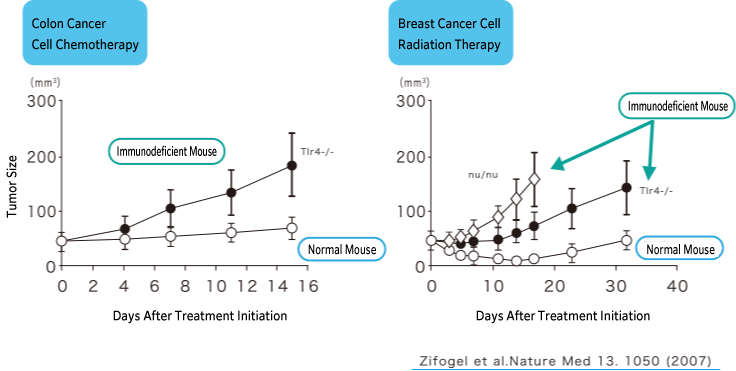
In mice lacking immunity, chemotherapy and radiation therapy are less effective
As shown in the graph above, it has been demonstrated that chemotherapy and radiation therapy are less effective in mice with weakened immunity.
Therefore, future cancer treatment should combine immunotherapy with surgery, chemotherapy, and radiation therapy to improve effectiveness.
Immunity is our body's natural defense mechanism. It is broadly categorized into two systems: (1) Innate immunity, which operates independently of specific antigens, and (2) Adaptive immunity, which targets specific antigens. The cells involved in each are listed below.
Dendritic cells (DCs) present cancer antigen (peptide) information to killer T cells via HLA class I molecules. Upon receiving this antigen information, killer T cells target and destroy cancer cells (positive immunity).
Molecules such as PD-1 and CTLA-4 interfere with this communication, acting as brakes on positive immunity—thus promoting negative immune responses.
Immune checkpoint inhibitors (such as Opdivo, Keytruda, and Yervoy) counteract this negative immunity by blocking these inhibitory signals and reducing the number of regulatory T cells (Tregs).
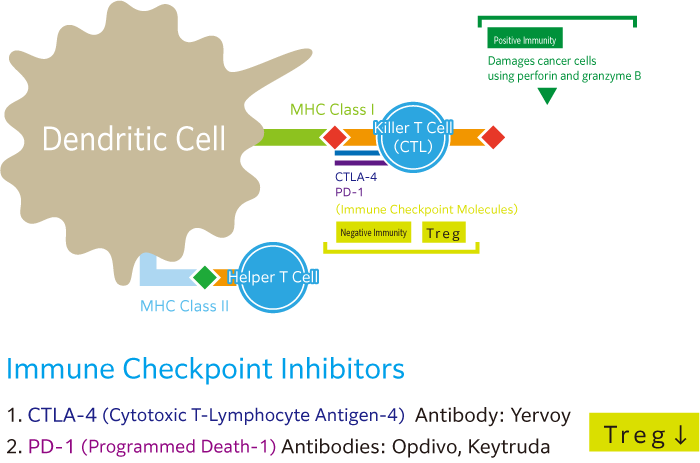
The fundamental concept of immunotherapy is to enhance positive (+) immune responses and suppress negative (−) immune responses. Below are the respective immunotherapy approaches.
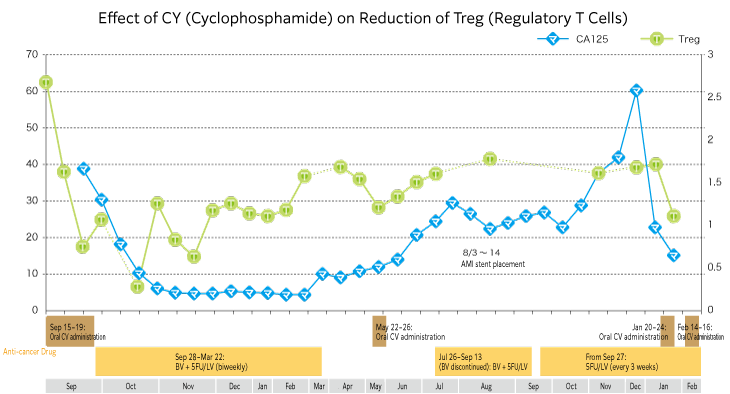
We present actual data from our clinic on changes in tumor markers and Treg (regulatory T cells) following the combined use of chemotherapy and immunotherapy.
While immune checkpoint inhibitors are known to reduce Treg levels, they are often costly. Therefore, at our clinic, we first reduce the negative immune response (Treg) using CY (Cyclophosphamide), which is a more affordable option. After that, we proceed with positive immunotherapy.